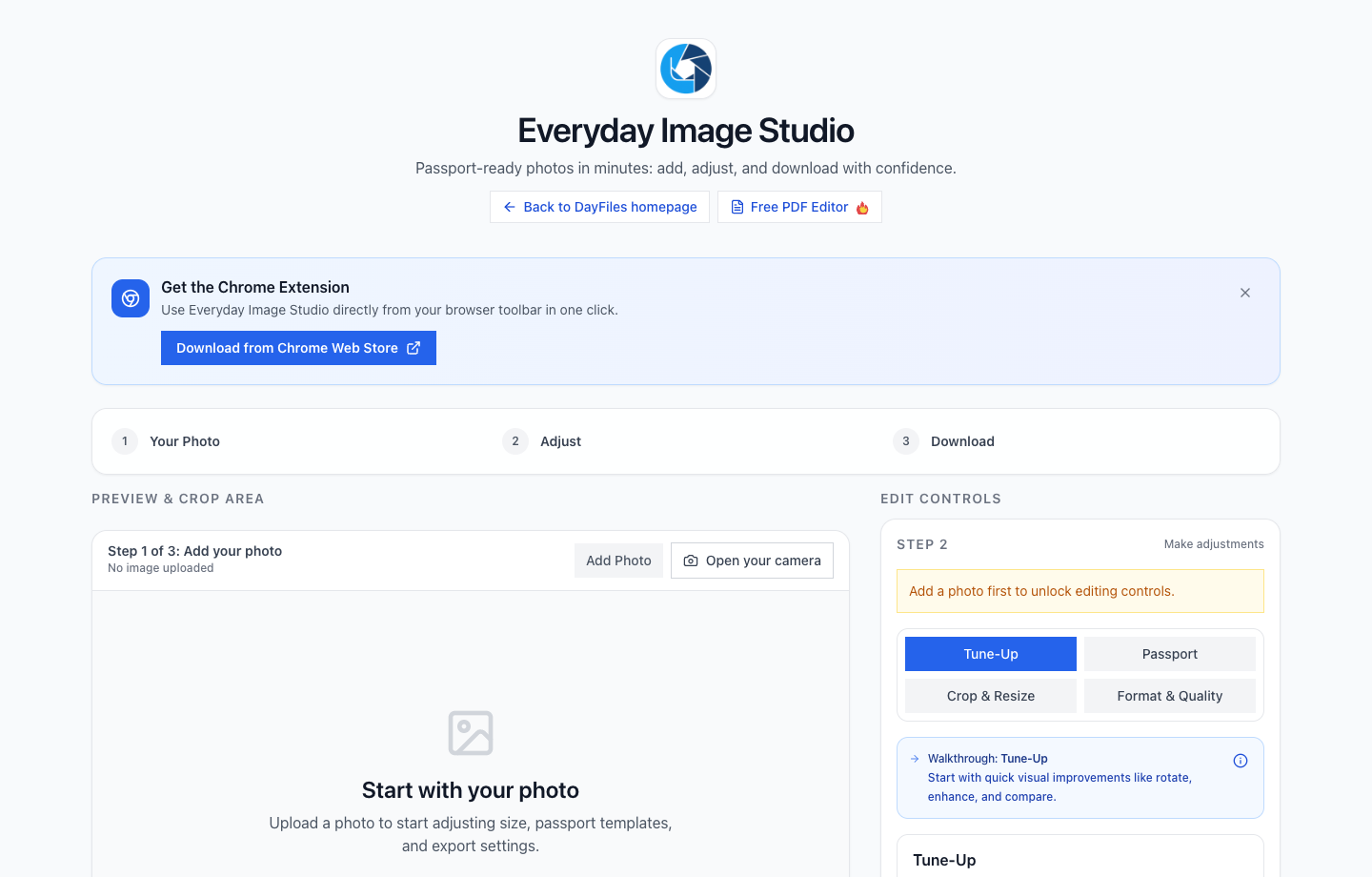
How should a small team use Everyday Image Studio to produce repeatable social assets without losing brand control? The clearest route is to decide formats, presets, and review gates before the editing sprint begins, then make the export handoff as consistent as the design work.
Dayfiles helps most when the team uses the tool routes as part of one visible sequence instead of scattered one-off fixes. The workflow gets stronger when each step has a clear owner and the next person can see what stage the file is in.
Which operating rules matter most for social asset production?
For social asset production, the rules worth locking early are:
- preset discipline
- channel sizing rules
- review ownership
- export readiness
Those rules reduce rework because they turn vague “someone should check this” expectations into named parts of the process.
What should the social asset production sequence look like?
- Confirm the source inputs and who owns the final review.
- Run the edit, packaging, or preparation step without mixing in unrelated file changes.
- Review the risky fields or pages before export.
- Export one clearly labeled output for the next handoff.
- Archive the final file in a way the next operator can trust.
That sequence is deliberately plain. Workflows become brittle when they collect too many optional branches. A small team usually needs a route that is easy to repeat, easy to teach, and easy to audit after a bad handoff.
When this workflow is the right fit
It is the right fit when the team needs repeatable production more than one-off experimentation. Social content gets expensive when every asset begins from scratch.
What should be decided before editing starts
Decide channel sizes, brand-safe presets, naming rules, and who signs off before export. Those choices remove a large part of the avoidable noise.
What the editing workspace should support
The editor should support fast iteration without hiding where the final asset will go. Teams move faster when the workspace still points back to the delivery requirement.
What the pre-review checklist should catch
Text cutoffs, wrong aspect ratios, unreadable mobile layouts, and export mismatches are the issues worth stopping for before the asset leaves the team.
What the downstream team should receive
They should receive a clean, labeled export set that clearly distinguishes drafts, approved assets, and resized channel variants.
What should managers or owners look for after social asset production rollout?
Look for fewer naming mistakes, fewer packet returns, fewer last-minute “which file is final?” questions, and faster review cycles on repeated work. Those are the signals that the workflow is actually reducing friction rather than just adding a better-looking process description.
Where should the social asset production workflow stay flexible?
Keep the destination rule, review rule, and archive rule firm. Stay flexible about the exact order of low-risk preparation tasks if the team has a good reason to change them. That balance helps the workflow hold up under real pressure. It protects the steps that prevent errors without forcing the team into unnecessary ceremony for every minor variation in the work.
What should happen when the social asset production workflow breaks?
Treat the break as a clue, not as proof that the workflow has failed as a concept. Ask which step allowed the mistake through, what evidence would have caught it earlier, and whether the file state was still visible to the next operator. Those questions usually reveal whether the fix belongs in intake, review, export, or archive discipline.
What should the receiving team see immediately after social asset production?
The receiving team should see one obvious final file, one obvious archive location, and enough naming clarity to understand the destination without reopening a long explanation thread. When that visibility is missing, even a careful workflow can feel unreliable from the outside.
This is why handoff clarity deserves its own checkpoint. A workflow should not only produce a correct file. It should also make the file legible to the next person who inherits it.
What should stay true even when the social asset production job changes?
Even when the document type, reviewer, or destination changes, the workflow should still preserve four basics: a known source of truth, a visible review moment, a deliberate export point, and a trustworthy archive. Those constants are what make the process usable across several kinds of file work without becoming vague.
Why a social asset production workflow ages well
It ages well because it focuses on file state, not temporary interface details. Tools will change and destinations will change, but teams will still need to know which file is approved, what changed, and whether the output is ready to move. A workflow built around those questions stays useful longer than one built around a narrow button path.
More Dayfiles guides for social asset production
- Everyday Image Studio Workflow Playbook for Daily Teams
- How to Resize Images in Bulk for Listings and Uploads
- images remove background product photos guide
What success looks like for social asset production
Success here means the next operator can pick up the file without guessing about status, sequence, or destination. When that is true, the workflow is carrying its weight instead of just adding another layer of motion.
That is also the standard that makes the article stronger. A workflow page about social asset production should leave the reader with a clearer operating model, not just a list of respectable-sounding principles.